
From Chaos to Clarity: Raising the Quality of PDCA Execution
March 1, 2026
PDCA (Plan-Do-Check-Act) is one of the simplest and most widely taught improvement methods in use today.
And because it is simple, it is often treated as a checkbox.
In many organizations, PDCA becomes something we do rather than something we think through. The form gets filled out, the meeting happens, and the cycle is “closed”—but little attention is given to the quality of the thinking that went into it.
Even more rarely is the PDCA itself reviewed. And rarer still are lessons learned captured in a way that improves the next cycle.
Over time, PDCA drifts from a learning system into a status update.
That’s the gap I want to address.
PDCA Doesn’t Fail Because It’s Flawed
It Fails Because We Don’t Coach It.
Most people understand the mechanics of PDCA. The failure isn’t a lack of knowledge—it’s a lack of discipline around execution and reflection.
In practice, I see the same patterns repeat:
Problems are described vaguely or too broadly
Hypotheses are implied, not stated
“Check” becomes opinion instead of evidence
“Act” defaults to standardizing without real learning
When that happens, PDCA stops being a learning cycle and starts being paperwork.
The method is still there. The thinking is not.
Re-centering PDCA on Thinking Quality
High-quality PDCA isn’t about perfect outcomes. It’s about clear logic, evidence, and learning.
That requires shifting the focus:
From activity → to cause-and-effect thinking
From speed → to clarity
From closing items → to improving how we reason
This is especially important for managers. PDCA doesn’t improve on its own—it improves through review and coaching.
If the PDCA review feels like a comfortable status meeting, it probably isn’t doing its job.
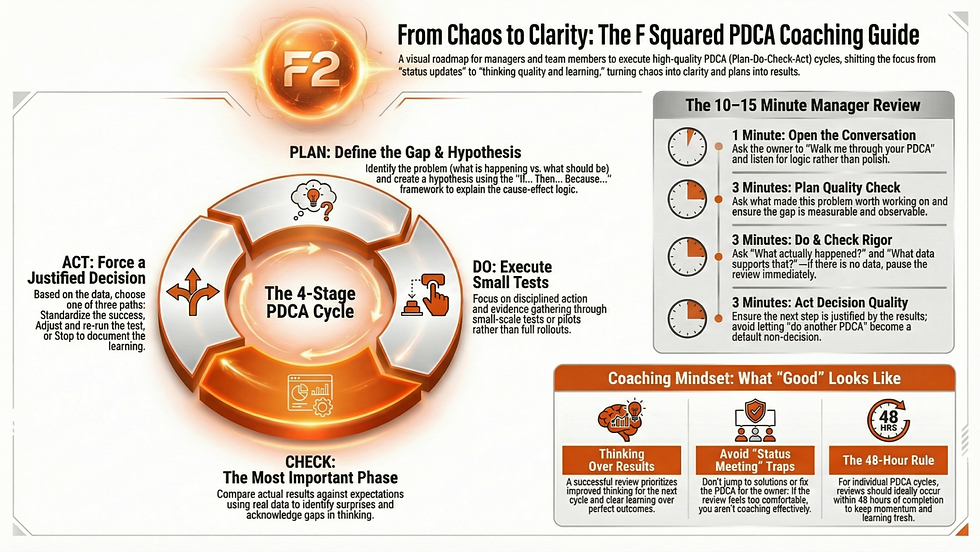
The 10–15 Minute Manager Review
One of the most effective changes I’ve seen is introducing a short, structured PDCA review focused on thinking quality rather than results.
A typical flow looks like this:
Open the conversation by asking the owner to walk through their PDCA logic
Check PLAN quality: Is the gap observable? Is the hypothesis causal?
Test DO discipline: Were actions designed to test the hypothesis or just “do something”?
Demand rigor in CHECK: What actually happened, and what data supports it?
Force an ACT decision: Standardize, adjust and re-run, or stop and document learning
Fifteen minutes is enough—if the focus is right.
What “Good” PDCA Looks Like
Good PDCA reviews share a few consistent traits:
They prioritize thinking over results
They avoid turning into solution-jumping sessions
They happen quickly, while learning is still fresh
They end with a clear decision and captured insight
The goal isn’t perfection. The goal is better thinking in the next cycle.
Why This Matters
Organizations don’t lack improvement tools. They lack systems that reinforce disciplined thinking.
PDCA, when executed and reviewed well, does exactly that. When executed poorly, it becomes noise.
Raising the quality of PDCA execution doesn’t require new frameworks. It requires intentional coaching, structured review, and respect for learning.
That’s where clarity replaces chaos.
A Practical Note
I recently packaged the tools I use to support this approach—PDCA execution, review, and coaching—into a small, practical system. It’s intentionally simple and designed for real operational use.
More importantly, it reflects how PDCA is meant to work when thinking quality is taken seriously.
A digital version is already on the roadmap.
Closing Thought
PDCA isn’t powerful because it’s easy. It’s powerful when we refuse to treat it that way.


Comments