
Is / Is-Not Analysis: How to Bound a Problem
June 13, 2026
One of the fastest ways to sharpen a fuzzy problem — and to get clues about its cause for free — is Is / Is-Not analysis. It’s a simple table that asks not just what the problem is, but, just as importantly, what it is not. Those contrasts keep a narrow problem from being described as a broad one, and they often point straight at where to look. Here’s how to use it.
Defining problems is step one of any RCA — see the https://www.fsquaredconsultinggroup.com/digitaltools Complete Guide to Root Cause Analysis.
What is Is / Is-Not analysis?
Is/Is-Not analysis comes from the Kepner-Tregoe problem-solving method. You specify the problem across a few dimensions — typically What, Where, When, and Extent — by filling in two columns: what the problem IS, and what it (could be expected to be but) IS NOT.
The “is not” column does the heavy lifting. Knowing a defect appears on Line 3 but not Lines 1 and 2 — when all three run the same product — immediately narrows where a cause could live. You’re drawing a tight boundary around the problem instead of waving at it.
Why the “is not” column matters
Most problem descriptions only say what’s happening. That’s half the picture. By also stating what isn’t happening (but plausibly could), you:
• Prevent over-scoping — “the whole family is failing” collapses to “only the 2L variant, only since May.”
• Expose distinctions — every difference between IS and IS-NOT is a candidate clue. What changed about Line 3, or about May, or about the 2L variant?
• Avoid wasted effort — you don’t investigate areas the problem demonstrably doesn’t touch.
How to do it, step by step
1. Start from your problem statement. https://www.fsquaredconsultinggroup.com/post/how-to-write-a-problem-statement How to write a problem statement.
2. For each dimension, fill the IS column — the specific facts of the problem.
3. Then fill the IS-NOT column — closely related things that are not affected but reasonably could be. (The trick: pick contrasts that are plausible, not absurd. “Is not happening on Mars” tells you nothing.)
4. Scan for distinctions and changes. For each IS vs IS-NOT pair, ask: what’s different, and did anything change there? Those become leads for your fishbone and 5 Whys.
A worked example
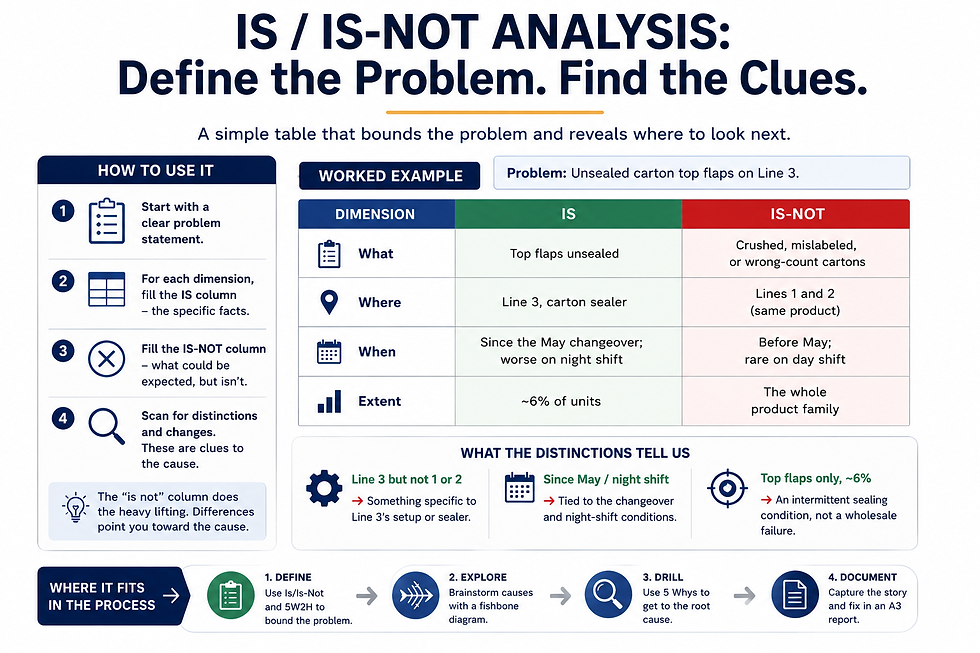
Problem: Unsealed carton top flaps on Line 3.
Dimension | IS | IS NOT |
What | Top flaps unsealed | Crushed, mislabeled, or wrong-count cartons |
Where | Line 3, carton sealer | Lines 1 and 2 (same product) |
When | Since the May changeover; worse on night shift | Before May; rare on day shift |
Extent | ~6% of units | The whole product family |
Reading the distinctions: - Line 3 but not 1 or 2 → something specific to Line 3’s setup or sealer. - Since May / night shift → tied to the changeover and possibly humidity or staffing on nights. - Top flaps only, ~6% → an intermittent sealing condition, not a wholesale failure.
Before drawing a single fishbone bone, Is/Is-Not has already pointed at the changeover, the Line 3 sealer, and night-shift conditions.
Where it fits in the process
Is/Is-Not lives in the define step, alongside your problem statement and 5W2H. Once the problem is bounded, take the distinctions you found into a fishbone https://www.fsquaredconsultinggroup.com/post/how-to-make-a-fishbone-ishikawa-diagram-step-by-step to brainstorm causes, then drill the strongest with 5 Whys. https://www.fsquaredconsultinggroup.com/post/5-why-examples-and-a-free-template
Do it free: The F Squared Problem Statement Builder includes an Is/Is-Not grid alongside 5W2H (and AI can suggest entries on Pro), then hands a sharp, bounded statement straight to the fishbone. Try it free →
Prefer paper? The free RCA Starter Kit includes a Problem Definition worksheet with an Is/Is-Not table. https://www.fsquaredconsultinggroup.com/digitaltools
Frequently asked questions
What is Is/Is-Not analysis used for?
To specify and bound a problem precisely by describing what it is and what it is not across dimensions like What, Where, When, and Extent — which sharpens the definition and surfaces clues to the cause.
Where does Is/Is-Not come from?
It’s part of the Kepner-Tregoe problem-analysis method, a structured approach to specifying and analyzing problems.
What dimensions should I use?
What, Where, When, and Extent are the standard four. You can add others (like Who) if they help, but those four cover most problems.
How is Is/Is-Not different from 5W2H?
5W2H gathers the facts of a problem; Is/Is-Not adds the crucial contrast of what the problem is not, which bounds the scope and reveals distinctions. They’re complementary — use both when defining a problem.
Does Is/Is-Not find the root cause?
Not on its own — it sharpens and bounds the problem and points you toward likely areas. You still confirm the root cause with a fishbone and 5 Whys.


Comments